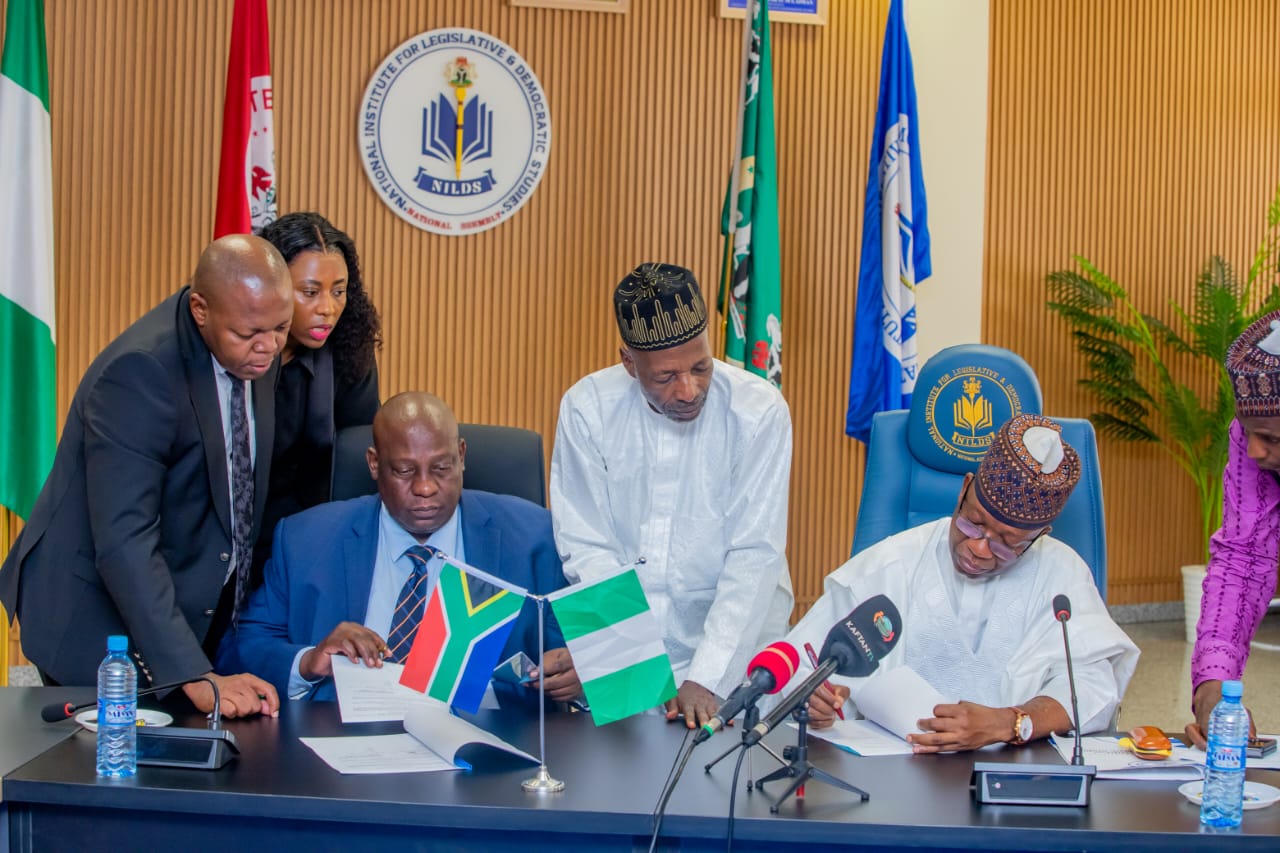
The National Institute for Legislative and Democratic Studies (NILDS) has sealed a Memorandum of Understanding (MoU) with the Gauteng Provincial Legislature of South Africa to enhance democratic institutions in both countries. The agreement, signed in Abuja, aims to establish a Gauteng Provincial Legislature Training Institute, which will provide legislative training, institutional frameworks, and funding models to strengthen governance delivery.
According to experts, the partnership is rooted in the shared values of democratic governance, constitutionalism, and African development. The two institutions have identified key areas of collaboration, including legislative training, institutional frameworks, funding models, and sustainability. The NILDS Director-General, Abubakar Sulaiman, noted that the MoU will enable both institutions to strengthen legislative effectiveness and improve governance outcomes for citizens.
The Gauteng Provincial Legislature delegation, led by Secretary Mpho Maloka, expressed enthusiasm for the partnership, citing the need to develop administrative and subject-matter expertise, as well as designing tailored training programmes suited to the unique needs of parliamentary systems. Maloka emphasized that the initiatives align with legislatures' core mandates of lawmaking, oversight, and public participation within a democratic governance framework.
The partnership is expected to yield practical solutions to strengthen legislative development in South Africa and across Africa's democratic landscape. As the MoU takes effect, both institutions will engage in productive discussions to ensure the successful implementation of the agreement.
The NILDS-Gauteng Provincial Legislature partnership is a significant step towards strengthening democratic institutions in Africa. By sharing expertise and best practices, both institutions can improve legislative effectiveness and governance outcomes for citizens. This collaboration has the potential to set a precedent for similar partnerships across the continent, ultimately enhancing democratic governance and development in Africa.