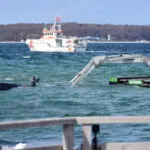
A German rescue team has been working tirelessly to save a beached humpback whale near Niendorf, a village close to the northern city of Luebeck. The massive sea mammal, measuring 10 metres in length, was first spotted on Monday, prompting a frantic effort to save its life. Various methods have been employed to dislodge the whale, including driving boats to create large waves and using a suction dredger to remove packed sand beneath it.
Despite these efforts, the whale remains stranded. At one point, rescuers managed to rotate the animal so its head faced deeper water, but it soon returned to its original position. On Thursday, the rescue team began using two excavators to dig a channel in front of the whale, in a bid to help it re-enter deeper waters.
Marine biologist Marc Lehmann examined the stricken creature on Thursday morning, noting that it was responding to its surroundings, with its eyes open and vocalising. However, the whale is terribly unsteady and appears to be scared. Even if successfully freed, the whale would still face a long and arduous journey back to its natural habitat in the North Sea and then on to the Atlantic.
The German rescue team's efforts to save the beached whale raise questions about the country's preparedness for marine animal rescues. The fact that the whale's navigation system may not be designed for navigating back to its natural habitat is a worrying concern. The rescue operation is a costly and complex affair, with the use of heavy machinery and expert personnel. The success of this operation will have significant implications for the welfare of marine animals in the region.