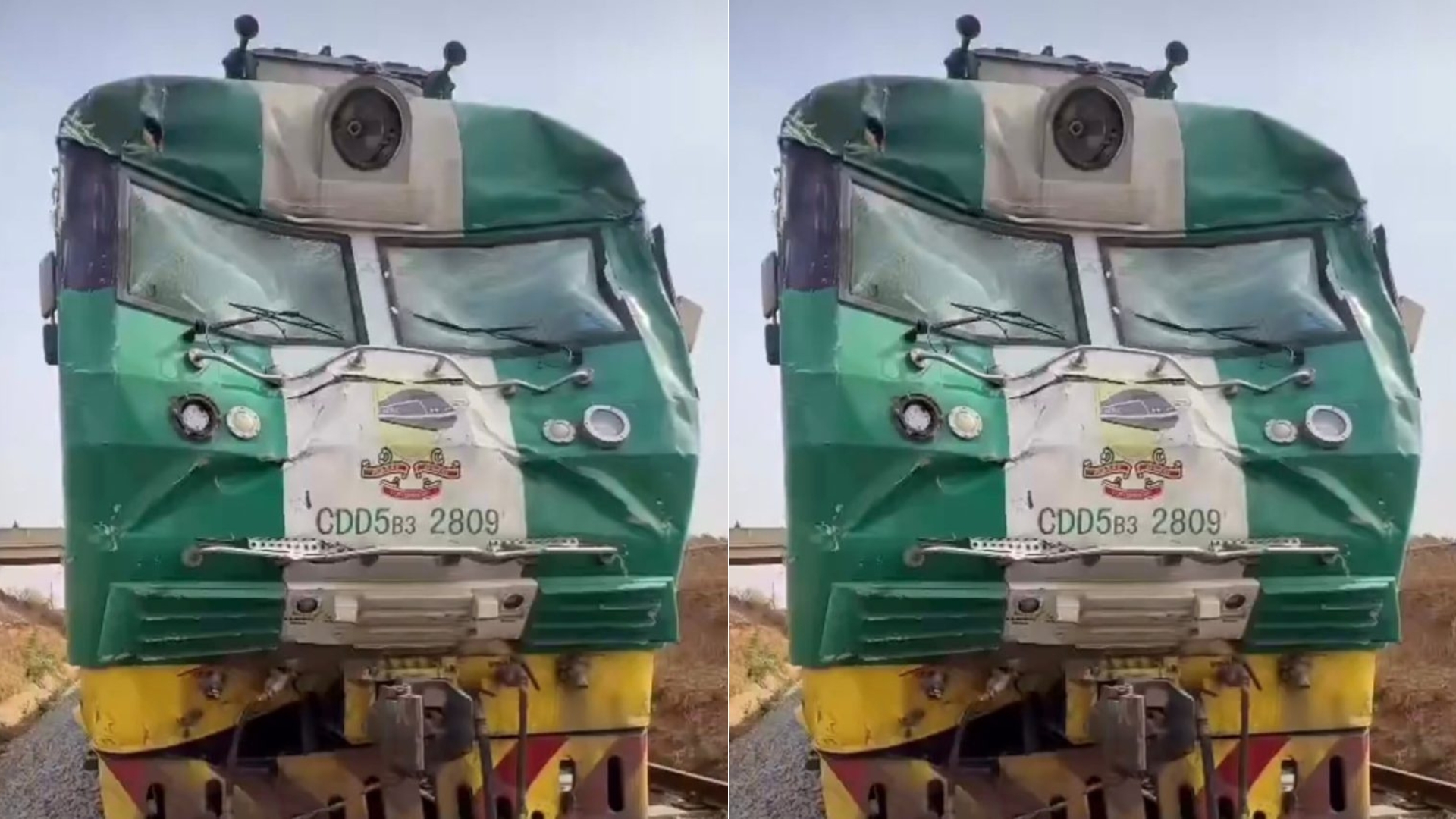
Witnesses recount Kaduna-Abuja train accident

Several passengers sustained injuries on Monday, following a collision by the Abuja-Kaduna train. The incident occurred near Asham along the busy rail line connecting Abuja and Kaduna.
It was gathered that several passengers sustained varying degrees of injuries during the incident and they were evacuated to a medical facility at the Idu Railway Station, for treatment.
Eyewitness accounts and videos which circulated on social media showed damaged coaches and railway personnel inspecting the affected train. Passengers were also seen gathered near the tracks after disembarking while rescue officials coordinated evacuation efforts.
SPONSOR AD
The management of the Nigerian Railway Corporation (NRC) confirmed that the incident occurred at about 10:30 a.m, near Asham, involving a rear locomotive and a passenger coach next to it due to a coupling issue.
NRC Managing Director, Dr. Kayode Opeifa said emergency response protocols were immediately activated, and relevant technical teams were mobilised to the location. He added that the Safety Investigation Bureau (SIB) was also on site to conduct a thorough investigation into the incident in line with established safety procedures.
“The train arrived Idu station at about 10.39am, 38minutes behind schedule due to time allowed to remove the incident rear locomotive and coach Sp 0006.
“The Corporation assures the public that safety remains its top priority, and all necessary measures are being taken to address the situation and ensure the continued safe operation of train services”, he said.
Accident avoidable – Witness
A witness who was on the train blamed the NRC for the accident and called for adherence to safety standards.
Speaking to Daily Trust on condition of anonymity, the witness said: “There should be a standard process where a coach is attached to a moving train. If there is a disconnect, there should be a way to safely create distance before anything happens.”
According to him, one of the coaches broke loose and rammed into the moving train.
“The operator stepped on the brakes, that’s why the moving train came from behind to hit us. He should not have done so. Maybe he panicked or maybe it was negligence.The passenger, who was seated in the sixth coach described the impact as massive.
“A lady sitting close to me fell off her seat. Another man hit his eye and had a cut. I hit my face and I felt pain in my nose. There was a lady that couldn’t move at all and needed urgent help,” he recounted.
He said passengers across six to seven coaches sustained varying degrees of injuries.
“You can imagine, each coach carries about 80 passengers. There were head injuries, fractures, dislocations, blood coming out of people’s noses. The nurse on board was overwhelmed,” he said.
Despite the chaos, the witness acknowledged NRC’s emergency response. “One thing you can give them is that before we arrived at Kugawa station, ambulances and health workers were already waiting. Those who needed medical attention were attended to quickly,” he noted.Going forward, he urged the NRC to prioritise safety.
“There should be strict adherence to safety measures and processes. If we do that, I think passengers will go home dry,” he said.
Another passenger, Sada Malumfashi, said, “We heard a loud bang and the train jolted to a stop flinging people across. Passengers got hit and most were bleeding and severely injured. The train delayed for some 30 minutes and resumed to Kubwa.”
Incident not a derailment
The Nigerian Railway Corporation clarified that the incident was not a derailment, contrary to some media reports. In a statement, the corporation explained that a derailment occurs when the wheels of a train leave the track, preventing the train from continuing its journey. According to the agency, this was not the case in the Asham incident.
The Managing Director of the Nigerian Railway Corporation said the train remained firmly on the track throughout the incident and was able to proceed safely to Idu Railway Station, where passengers disembarked without further complications.
Meanwhile, the Nigerian Safety Investigation Bureau (NSIB) said it has commenced an investigation into the incident.
Mrs Funke Arowojobe, Director, Public Affairs and Family Assistance, Nigerian Safety Investigation Bureau, in a statement said, “The occurrence took place at approximately 09:16 hours along the Jere–Asham section near Asham Station in Kaduna State. The section of track where the event occurred is located on a downward gradient.
“The train, identified as KA2, departed Rigasa Railway Station in Kaduna at the commencement of its scheduled journey to Idu Station in Abuja. The train operated within the scheduled service window of 07:15 to 10:01 and arrived at Jere Station at 08:52 before departing again at 08:59 to continue the journey toward Abuja.
Upon arrival at Jere Station, a rear locomotive was attached to the train to provide additional operational support for the onward movement along the corridor. Shortly after departure from Jere station, the rear locomotive became detached while the train proceeded along the downward gradient toward the Asham section. The detached locomotive subsequently rolled forward and struck the rear portion of the train, resulting in a serious operational occurrence.”
The bureau said its investigators have commenced evidence gathering and analysis to determine the circumstances surrounding the occurrence.
“The investigation will examine technical, operational, and infrastructure factors, including train configuration, locomotive attachment systems, operational procedures, and relevant operational data,” the statement added.
Commenting on the incident, the Director General of the Nigerian Safety Investigation Bureau, Captain Alex Badeh Jr., expressed concern for the affected passengers and reaffirmed the Bureau’s commitment to uncovering the facts behind the occurrence.
“This incident reminds us that every transport journey carries the trust and expectations of hundreds of people who rely on the system to move them safely to their destination. Our thoughts are with the passengers who sustained injuries, and we commend the swift response of the Nigerian Railway Corporation personnel and emergency teams who assisted those affected. Our team will carefully examine every relevant factor to understand what happened and to ensure that the lessons from this occurrence lead to safer railway operations across Nigeria,” he said.
Major incidents on Abuja–Kaduna rail line
The Abuja–Kaduna rail corridor remains one of Nigeria’s most important passenger rail lines. Since its inauguration in 2016, the service has become a preferred travel option for commuters due to insecurity along the Abuja–Kaduna highway.
Monday’s incident has again drawn attention to operational safety on the corridor, which has experienced a number of disruptions and security-related challenges in recent years.
Although the railway is widely regarded as a safer alternative to road travel, it has witnessed several notable incidents since operations began.
The most deadly incident occurred on March 28, 2022, when the Abuja–Kaduna passenger train was attacked by armed bandits near Katari in Kaduna State. During the attack, terrorists detonated explosives on the rail track before opening fire on passengers.
The assault resulted in the death of at least 10 passengers, while more than 60 others were abducted by the attackers.
In June 2024, there was a derailment of the train at the Asham station in the Chikun area of Kaduna State. At the time the NRC blamed the incident on vandals. The incident occurred shortly after the train departed the Kubwa station in the nation’s capital.
In a statement, the NRC said the train “experienced train technical hitch in our operation at Asham Railway Station in Chikun Local Government of Kaduna State.”
Another incident occurred in August 2025, when a passenger train derailed along the Abuja–Kaduna corridor. More than 20 passengers reportedly sustained injuries in the derailment, which occurred while the train was travelling with hundreds of passengers on board.
Transport safety analysts have often pointed out that while the Abuja–Kaduna rail service has significantly improved inter-city travel between the two cities, maintaining infrastructure integrity and improving surveillance along the line remain critical to preventing accidents.
Prof. Ibe Callistus, a transport analyst, said the incident is not unusual, saying in transportation, an accident can occur anytime but such an incident must be reduced to the barest minimum.
“We need to keep improving on our efficiency level, we need to keep improving on accident preventive measures.
“We should keep equipping ourselves, having automatic equipment that could alert us if such things are coming. We must have sensors that would alert us before such an incident happens. What happened was a little incident and I am happy the Accident Bureau are on it and they would find out the root cause of it,” he said.
Source: Original Article • AI-enhanced version for clarity & Nigerian context
Related Stories