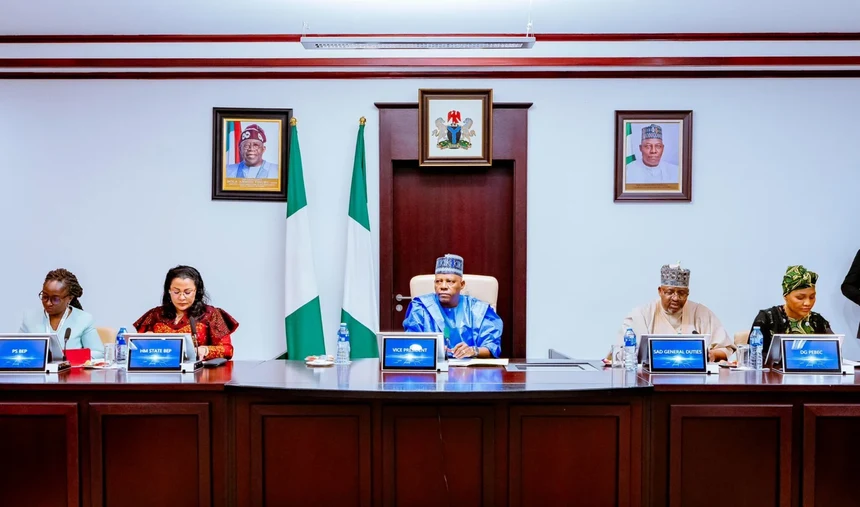
Vice President Kashim Shettima urged state governments to accelerate reforms to access the $750 million World Bank-assisted State Action on Business Enabling Reforms (SABER) programme. He made the appeal during a stakeholder meeting in Abuja on Tuesday, stressing the need for states to create a predictable and transparent business environment. Shettima said the programme would attract domestic and foreign investment, strengthen private-sector confidence, and reduce the cost of doing business. He added that it would expand digital and physical infrastructure, improve land access, and boost state competitiveness.
These outcomes, he stated, would lead to increased economic activity, higher productivity, job creation, improved internally generated revenue, and better living standards. Shettima directed the Director-General of the Presidential Enabling Business Environment Council (PEBEC), Zarah Mustapha-Audu, to initiate steps to extend the programme's lifespan by one year to allow full utilisation. He linked the success of President Bola Tinubu's economic reforms to the creation of an enabling environment for businesses. Shettima noted that while federal reforms are ongoing, many business conditions are determined at the subnational level, making state participation in SABER critical.
Minister of State for Budget and Economic Planning, Dr Doris Uzoka-Anite, urged stakeholders to address implementation bottlenecks. She expressed confidence that states would access the performance-based $750 million intervention, designed by the World Bank and PEBEC Secretariat. Mustapha-Audu confirmed that funds are tied to deliverables and that progress is being made by participating states in meeting disbursement-linked indicators.
Shettima is pushing states to claim $750 million in World Bank funds while his own administration's reforms remain tied to performance benchmarks. If federal progress depends on subnational action, then states' slow uptake reflects a misalignment in priorities between Abuja and the regions. The call for a one-year extension suggests the timeline for delivering results may already be slipping. Nigerians in states that fail to meet disbursement indicators will see no improvement in jobs or infrastructure.
💡 NaijaBuzz Take is AI-assisted editorial opinion, not established fact. Full disclaimer →