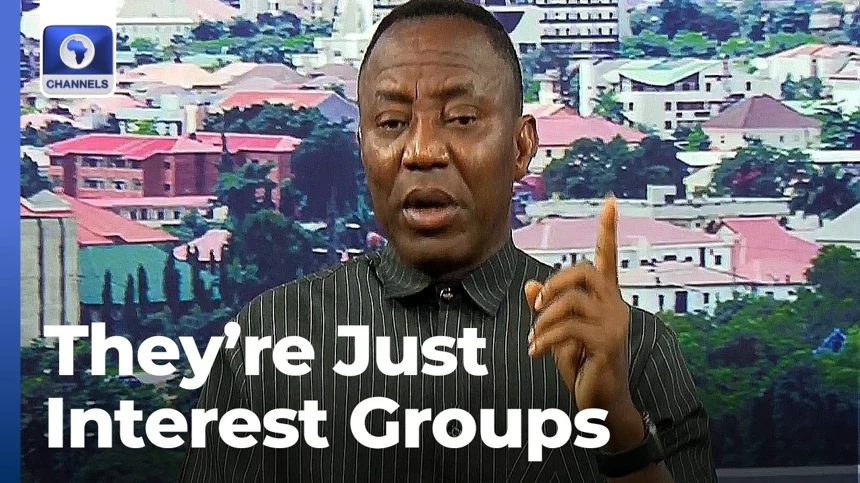
Omoyele Sowore, former presidential candidate and human rights activist, has dismissed political alliances forming ahead of the 2027 general election, describing them as power-seeking groups rather than genuine coalitions. He made the remarks during an interview on Channels Television's The Morning Brief on Monday. Sowore argued that the current alignments, including the Nigeria Democratic Congress (NDC), do not represent broad-based unity but are driven by individual ambitions. "It has come to pass; they are not a coalition. These are just interest groups and persons who are interested in power," he said.
He referenced the 2015 political shift that brought the All Progressives Congress (APC) to power, noting that it was not merely a party merger but a reflection of public dissatisfaction with the People Democratic Party (PDP). According to Sowore, today's political movements lack that popular mandate. He pointed to recent defections of Peter Obi and Rabiu Kwankwaso from the African Democratic Congress (ADC) to the NDC, citing internal crises as their reason. Sowore dismissed the NDC as not a coalition but a party created through a court order in Kogi State.
"The latest coalition, which is the NDC, is not even a coalition but a political party that came into existence in the way of a court order obtained from Kogi State. It's not a coalition; it's owned by an individual, the former governor of Bayelsa State," Sowore stated, referring to Nyesom Wike. He affirmed that his party, the African Action Congress (AAC), founded in 2018, has endured significant challenges and remains independent of such alliances. Sowore maintained that Nigerians are more aware now and unlikely to be misled by formations that include figures associated with past governance failures.
Sowore criticizes coalitions as power grabs while positioning his own AAC, which has not won any major election since its 2018 founding, as a credible alternative. His argument against party mergers led by established figures applies equally to his continued leadership of a party with minimal electoral success. If Nigerians are now too wise to be deceived by familiar faces, the same scrutiny extends to those promoting untested platforms. His stance raises questions about what tangible political shift he envisions beyond rejection.
Editorial note: AI-assisted opinion, not established fact. Full disclaimer →


