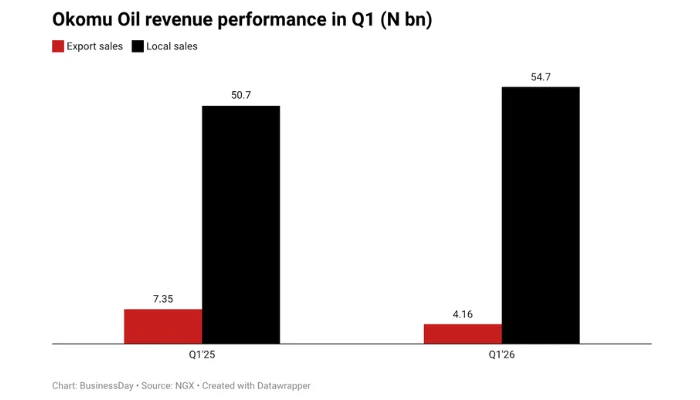
Okomu Oil Palm Plc reported a 13.8 percent rise in revenue to N58.95 billion for the first quarter of 2026, up from N51.81 billion in the same period of 2025. The growth was driven entirely by domestic sales, which climbed to N54.79 billion from N50.76 billion and now account for 93 percent of total revenue. Export sales, in contrast, fell sharply by 37.7 percent to N4.16 billion from N7.36 billion a year earlier, marking a continued decline in overseas contributions. The drop coincides with stabilisation of the naira, which had previously boosted export earnings through forex gains.
Profit growth lagged behind revenue, with profit before tax rising 5.9 percent to N34.1 billion and profit after tax increasing 8.6 percent to N23.6 billion. A surge in finance costs, up over 70 percent to N1.38 billion from N806.8 million, weighed on earnings. This was largely due to exchange losses, which doubled to N1.24 billion from N675.9 million. Finance income also dropped to N1.1 million from N66.7 million. Despite this, core operations strengthened, as cost of sales fell 24.4 percent to N11.7 billion, lifting gross profit to N47.4 billion from N36.3 billion. Operating expenses rose 18.2 percent to N11.8 billion, but operating profit still increased to N35.5 billion from N33 billion.
Net assets grew to N72.4 billion from N48.8 billion, while revenue reserves expanded to N72.6 billion from N48.95 billion. Biological assets, including fresh fruit bunches and rubber inventories, stood at N5.28 billion. However, cash flow weakened, with net cash from operating activities dropping 43 percent to N21.5 billion from N37.7 billion. Cash and bank balances declined as more funds were absorbed into working capital. The company's share price rose to N1,575 as of June 11, up 43.8 percent from N1,095 at the start of the year. Okomu Oil now has a market capitalisation of N1.5 trillion, ranking it 22nd on the NGX and representing 0.957 percent of the exchange's total equity market value.
Okomu Oil is relying more on Nigerian consumers even as its export income collapses by over a third. The company's cash generation dropped by more than 40 percent despite rising profits, raising concerns about liquidity pressures. Nigerians buying Okomu shares may be pricing in growth that the business is no longer delivering in hard cash.
Editorial note: AI-assisted opinion, not established fact. Full disclaimer →


