Nigerian man sentenced to 90 months imprisonment in US for fraud and money laundering
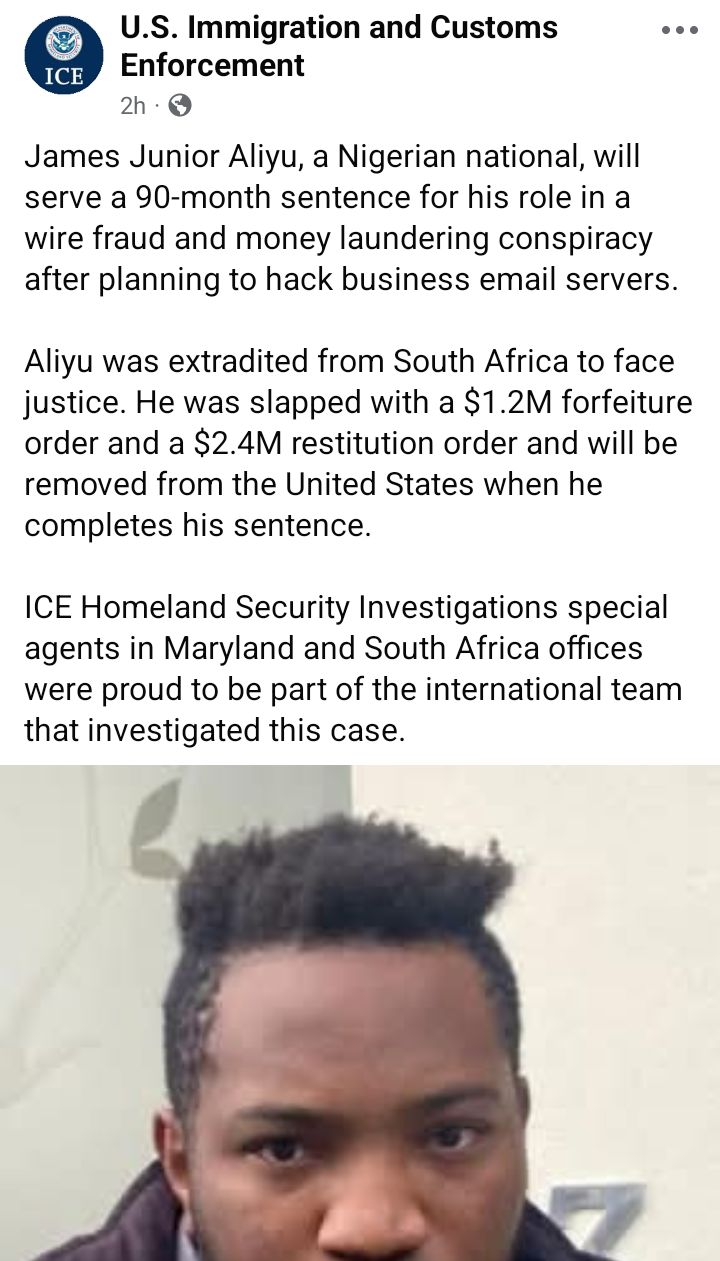
**Nigerian Man Sentenced to 90 Months in Prison for Fraud and Money Laundering**
A United States court has sentenced James Junior Aliyu, a Nigerian national, to 90 months in prison for his role in a large-scale wire fraud and money laundering conspiracy. Aliyu, who was arrested and extradited from South Africa to the United States, is the last of three defendants to plead guilty to his role in a business email compromise (BEC) scheme.
The U.S. Immigration and Customs Enforcement (ICE) announced the sentence in a statement on Saturday, March 21, 2026. In addition to his jail term, the court ordered Aliyu to forfeit $1.2 million and pay $2.4 million in restitution to victims affected by the fraud. ICE further disclosed that Aliyu will be deported from the United States upon completion of his prison sentence.
According to a statement from ICE, Aliyu will serve a 90-month sentence for his role in a wire fraud and money laundering conspiracy after planning to hack business email servers. "Aliyu was extradited from South Africa to face justice," the statement read. "He was slapped with a $1.2M forfeiture order and a $2.4M restitution order and will be removed from the United States when he completes his sentence."
The case against Aliyu and his co-conspirators began in 2019, when a federal grand jury returned an indictment charging Aliyu, Kosi Goodness Simon-Ebo, 30, and Henry Onyedikachi Echefu, 31, for conspiracy to commit wire fraud and money laundering. All three are Nigerian citizens who resided in South Africa at the time of the crimes. Federal authorities unsealed the indictment on July 6, 2022, upon the defendants' arrests outside of the U.S.
Aliyu pleaded guilty to conspiracy to commit wire fraud and money laundering. According to his plea agreement, from February 2017 until at least July 2017, Aliyu conspired with others to perpetrate a BEC scheme. The co-conspirators sent false wiring instructions to the victims' email accounts from "spoofed" emails to deceive the victims into sending money to bank accounts controlled by the scheme's perpetrators.
Eight other defendants previously pleaded guilty in the District of Maryland in separate cases related to the same conspiracy. "ICE Homeland Security Investigations special agents in Maryland and South Africa offices were proud to be part of the international team that investigated this case," the statement from ICE read.
The BEC scheme involved gaining unauthorized access to email accounts associated with individuals and businesses that they targeted. The co-conspirators then sent false wiring instructions to the victims' email accounts from "spoofed" emails to deceive the victims into sending money to bank accounts controlled by the scheme's perpetrators.
Source: Original Article • AI-enhanced version
Related Stories