INTERVIEW: France’s presence in Africa has never been so big, despite AES – French Ambassador
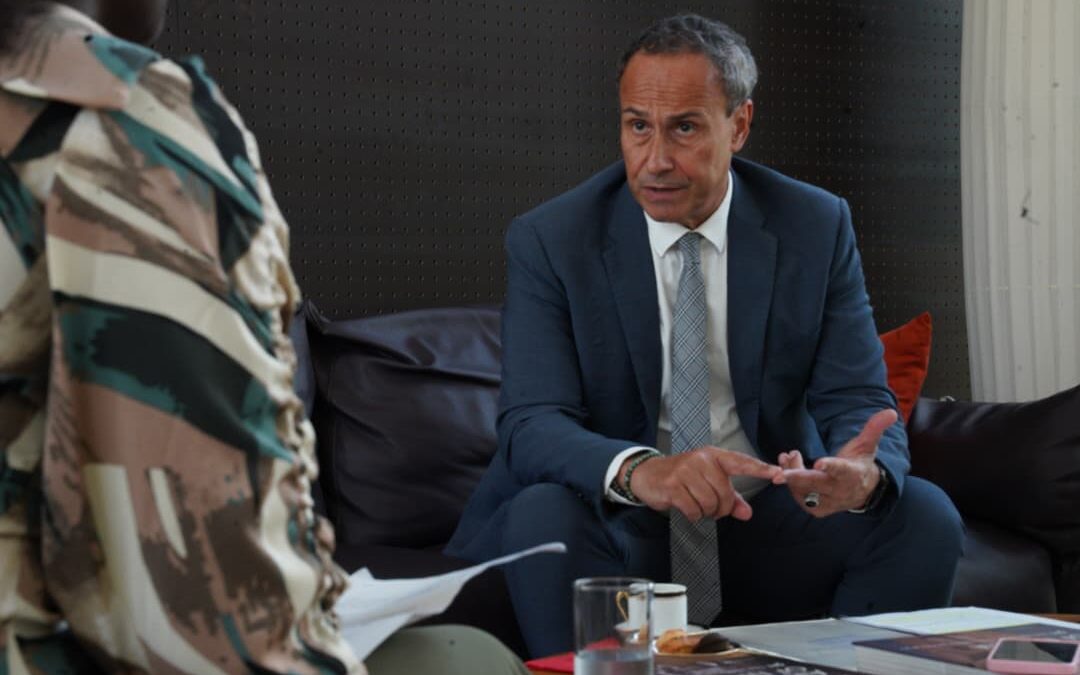
In this interview with PREMIUM TIMES, the French Ambassador to Nigeria, Marc Fonbaustier, discussed France’s relations with Nigeria, Francophone African countries, the evolving dynamics of transatlantic ties, tensions surrounding the US Board of Peace, and France’s vision of strategic autonomy in a changing global order.
The interview was conducted before the start of the US-Israeli war on Iran, and so no questions were asked about the war.
Excerpts,
PT: On the Board of Peace, why did France decline the US invitation despite voting for the board’s creation on the Security Council?
Mr Fonbaustier: We voted Resolution 2803 in the specific context of the situation in Gaza. France has indeed been invited by the United States to join the Board of Peace, but we have not followed up yet. The scope of the Board of Peace, as well as its legal and policy framework, still needs to be clarified.
France maintains its commitment to the United Nations as the cornerstone of effective and rule-based multilateralism, based on international law, equality between sovereign States and peaceful settlement of disputes. At the moment, the Board of Peace seems “far, very far from the Charter of the United Nations” – as recently stated by the French Minister for Europe and Foreign Affairs, Mr Jean-Noël Barrot.
The Board of Peace is an unprecedented initiative, and as such, it must be analysed in a rational, legal, and political manner before participation can be considered. In any case, sovereign States should not be forced or pressured to join such an initiative.
PT: Do you think the US push for Greenland undermined EU strategic autonomy?
Mr Fonbaustier: The recent US stance on Greenland is indeed a test for European credibility: the French President recently spoke about the need for a “strategic wake-up call for all of Europe” alongside Greenland’s Prime Minister Jens-Frederik Nielsen and Denmark’s Prime Minister Mette Frederiksen. It confirms the relevance of the concept of strategic autonomy that France has been using since the mid-1990s and that we have been implementing in practice for even longer, in the wake of Général de Gaulle’s focus on national independence.
PT: Have the US’s recent actions shaped or constrained France’s foreign policy decision-making?
Mr Fonbaustier: There has been an old and strong friendship between our two countries and people since the American War of Independence, during which France provided key support to the new United States, consolidated by the help we received from the United States during the two World Wars.
Today, we are allies, which does not mean we are always aligned. It is our right and our responsibility to say no when we disagree – like we did when we refused to take part in the 2003 Iraq War.
The US’s recent actions have not constrained France’s foreign policy decision-making; on the contrary, as they have proved a point we have been making for decades, arguing that Europe should be responsible for its own security and cannot depend excessively on an external partner.
The publication of the latest US National Security Strategy was a moment of clarification in this regard and confirmed for the EU the clear need to move towards more strategic autonomy.
PT: What new strategies has the EU been considering to end the Russia-Ukraine war?
Mr Fonbaustier: At the latest meeting of the Coalition of the Willing in early January, France expressed its resolute commitment to a sustainable peace process for Ukraine again, again, leading to a just, lasting and solid peace. We expect Russia to engage in good faith and seriously in negotiations, as it has unfortunately violated the peace agreements that it has signed over the past fifteen years.
In that regard, we have highlighted five priorities in order to put an end to Russia’s war of aggression:
First, establishment of a mechanism to monitor the ceasefire, under US leadership and with contributions of other States; Second, support to Ukrainian armed forces, which are and will remain the first line of defence and deterrence; Third, continued deployment of a multinational force for Ukraine, intended to be a reassurance force after the ceasefire; Fourth, legal translation of these commitments in order to support Ukraine in the event of further aggression by Russia after a ceasefire; Fifth, economic and reconstruction support for Ukraine, as well as long-term defense cooperation with Ukraine.
PT: France’s once-dominant influence in Francophone Africa has been fading, particularly since it lost its former colonies. How is France dealing with this? Are there plans to rebuild the relationship?
Mr Fonbaustier: Your question, in a nutshell, is how we see our partnership with Africa and African countries currently. Never forget that there are 54 countries in Africa with which we have long-standing relationships.
We deal with sovereign countries, which means that what has happened in francophone countries, particularly the Sahel, does not summarise our relationship with other countries on the continent. But when we say we deal with sovereign countries, we mean this with the understanding that things can change at any time.
There are countries who asked France to intervene to support them against terrorism. For instance Mali, we intervened at the request of a sovereign state, and it is reversible. When the sovereign state asks us to withdraw, we do it. It is as simple as that. I think the focus should be excessively on Sahel states and the military presence. It extremely reduces the full picture.
Also, France did the same with the United States in 1966, when President de Gaulle wrote to the US President to say you have to withdraw your troops from France. So we know what sovereignty and national integrity can mean. Nigeria knows it as well.
Now, if I look at the broader picture, honestly, we have a very balanced relationship with all types of countries, Francophone, English-speaking countries, and Lusophone countries. We think, contrary to some biased approaches, the trend is upward. Clearly, the French presence has never been so big. We are the second-largest investor in Africa after the UK, and we are the first country in the world to host African students from outside Africa.
So I think somebody who says there is a French retraction or diminished presence in Africa is making a very wrong assessment.
PT: Your response has a broader perspective on France’s relations with African countries. However, could you speak to any ongoing efforts to repair strained relations between France and its former West African colonies?
Mr Fonbaustier: Two things. First, what is sad and wrong, I think, is to make France a scapegoat. It is too easy when you have poor governance, as we have now in some countries, ex-Francophone colonies, to put the burden on France and say we are the scapegoats.
That, I think, does not work well, first, and is not fair. Now, as to what is the new approach is, I think everything has been said by President Macron in 2017 in Ouagadougou. He delivered a very important speech that served as the foundation for the new policy.
What is the new policy? It is a partnership. Partnership between equals, on equal footing, and co-built, which means France is not imposing solutions from abroad.
We are co-building with responsible governments, nations, and populations so we can address common challenges, because we have linked destinies. We have common interests, common challenges, and linked destinies. Equal footing, true partnership, fair, with no hidden agenda. That’s exactly what we are doing now in all countries, particularly, to be honest, with Nigeria.
Nigeria, for us, is the typical, perfect partner for the French policy as it stands in Africa. There is no hidden agenda. We are two trying to be one. We listen to each other and try to adapt and solve challenges together.
PT: How does France view Niger’s claim that it, along with Benin and the Ivory Coast, backed an attack at Niamey’s airport?
Mr Fonbaustier: These allegations, as so many others, are groundless. France has been West Africa’s most committed partner in the fight against terrorism over the past fifteen years. 58 of our soldiers were killed during anti-terrorist operations carried out at the request of West African States. More than 250 of our citizens have been killed by jihadi groups since 2012.
Europe and West Africa have a common interest and a shared destiny: a stable and prosperous world in which terrorist groups do not have any safe haven.
PT: France appears to be strengthening its ties with Nigeria. President Bola Tinubu has made several trips to France in the past two years, and in 2023, the French Minister for Europe and Foreign Affairs, Catherine Colonna, visited Nigeria. Is this growing relationship a result of France losing influence in its traditional Francophone partner countries?
Mr Fonbaustier: No, I think if you look at history and facts, you’ll find that this was not the case. We have started the shift towards English-speaking countries long before. It was in the 90s. I think when President Mitterrand and, later, President Chirac were in charge, we thought we were not sufficiently present in former British or Dutch colonies and that we needed to be more present.
So, the shift started far earlier, number one.
With Nigeria, we established quite a good relationship after the dictatorship, when we returned to civilian rule in 2000. The first state visit of President Obasanjo was to France in 2000. So, you see, it’s decades before the so-called degradation of our ties with AES countries.
Number three, we have fostered the pace, and it’s been fostered like this during the term of President Hollande, who came to visit you, and President Buhari made a reciprocal state visit to France. Now, there was the state visit of President Tinubu. What I want to illustrate is that it has a long history. It did not start at all with anything linked to Francophone countries. It’s part, as I said to you, of a broader ambition to be present in all of Africa.
We have a look at the broad continent, not one reduced to the ex-Francophone colonies. That would be far more reductive than what we have in mind, you see. And Nigeria is typically a pivotal state for that purpose.
We are so big, so important, so influential in West Africa and even across the broader continent that it was very important for us to be present and partners from the beginning.
PT: Francophone nations in Africa want more control over the management of their currency. However, France still upholds the decades-old system in which foreign exchange reserves are held at the French Treasury. Why so, and are there plans to suspend this practice?
Mr Fonbaustier: It’s always based on the maturity of the relationship between France and these countries, and the degree of reform they want to achieve.
It seems that in West Africa, things have gone better and faster. You see? But what happens, and I want to rebound on your question because it’s a very good one. I never accepted criticisms about a so-called colonial military policy. From 2018 to 2019, reforms have been achieved in the West African region. France is not a member of the bodies that now rule the monetary union in West Africa.
We are no longer members of the Central Bank of West African states. And this obligation, as you said rightly, of depositing reserves in the French treasury has been lifted. So we are absolutely confronted again with sovereignty matters, and currency is key to sovereignty.
For instance, Mali left the Monetary Union of West Africa in 1962. Then they came back in 1984. Mauritania decided to leave in 1973. But Guinea-Bissau decided to join in 1997. So it’s just to illustrate to you the fact that we are again confronted with a sovereignty policy. If the degree of maturity for structural reforms has not been reached in Central Africa, it is not France’s onus. It is because I think these countries have not been in a position to align their views or to promote anything new.
But I would not comment too much on Central Africa, because it is not my area of competence, you will understand. It is easy to say that, but it’s the truth. I am concentrating more on West Africa, and I just wanted to kill these fake news or false ideas about France still controlling or dominating poor countries that are servants of the French treasury. This is over, and I hope I have been convincing, because there is no more organic link between the French treasury, the French central bank, and the members.
Now the question of CFA’s future is still on the table. You have pros and cons. Some will criticise. Very, very wise economists from Africa say it’s not good to have this type of currency. Others, on the contrary, say it’s very favourable to trade, to stability, etc.
I’ll take note of one fact: the three AES members who are so bullish on colonialism have not left the CFA. Why is that? CFA provides a remarkable currency exchange rate stability, and this is extremely important when you want to attract investors, when you want to keep a global balance on your macroeconomic trends, on your budget, and on your fiscal resources. It’s very important.
When a currency is sloping or going upward, it’s not easy.
CFA is a stable currency. So I’m not pledging for CFA in particular, but I just mean that it has a certain value to have an exchange rate that is guaranteed. In Central Africa, I repeat, I am not so competent. I just think there is a degree of maturity of a debate that has been faster in West Africa, and I’m happy with it because West Africa is a region I like, and I favour very much in my career.
PT: French was once widely taught in Nigerian schools, and the French language and culture had a strong presence in the country. However, in recent years, many schools have lost French teachers, and the language has declined. Are there any existing partnerships aimed at revitalising the teaching of French in Nigerian schools?
Mr Fonbaustier: I take your point. It’s very valid. There is one thing to correct, however. French in Nigeria is not only a matter for France, but it is also a matter for Nigeria, because geography is a serious factor. You are surrounded by French-speaking countries.
If you want to exchange more with these countries, to be more brothers and sisters, you need a lingua franca. It can be English or French. So expanding French teaching in Nigeria is an issue, a stake, for Nigeria first of all, and for the neighbours.
Now, we are absolutely sensitive to the issue you are raising. I remind you that we have had capacity-building projects between 2023 and 2025 in five states. There was FCT Lagos, Oyo, Plateau, and Enugu. In these states, we have developed a capability-building project, and I think 130 teachers in French have been taught and reinforced, and 50 pilot schools have been set up. So it’s nothing.
Of course, it just finished now, so we have to take stock of the results. I hope it’s been something that has shaped a bit, you see, a more robust French-speaking community. That’s what we have in mind.
Number two, there is this Nigerian-French language village in Badagry. Not given up, it’s still valid, it’s still active. I sometimes meet people who have been through this village, and they speak French to me. It’s very funny, and it’s nice.
Number three, I also have a new project ahead. It will be a two-year project called Bilingual and Competitive, and it will be focused on employability. French is not only a language for culture, but it is also a vehicle to get a profession, a good training, and a good technical expertise. We mix up employability, professionalism, and the French language.
And so it will be very much focused on this, and the programme will be to set up French resources and employability centres in 15 universities. So you see, we will touch universities, and in these universities, there will be a kind of platform which will focus on French and employability.
So that’s number three. Number four, as you know, we have a network in the country which is, I think, undisputed, with 10 Alliances Francaises and the Institut Français du Nigeria here in Abuja. It means 11 centres where people can learn French and study French.
And number five, we have a project with the Ministry of Defence to set up a Centre d’enseignement du français, a kind of laboratory of French language for the armies. This is on track. It’s going to be built over the upcoming months.
I don’t focus on the military at all. It is just that there is also a need for your military to speak better French than they used to. It will help when they take part in UN peacekeeping missions, et cetera. This goes to show that we have an array, a spectrum of programmes, projects, structures, which can work to sustain French as a valid language for the population of Nigeria.
So we don’t give up at all. We think, on the contrary, that we have to foster the trend and to, I would say, encourage as many Nigerians as possible to learn French.
But you’re right, it’s a challenge. Your population is growing big, fast. You have a natural inclination for English, and I respect that very much. But it’s very important that in this process, we don’t lose French. It must remain in the scope.
PT: Many Nigerians are interested in pursuing a degree in France, yet French institutions seem to attract relatively little attention. Are there any plans to increase the appeal of French schools to Nigerian students?
Mr Fonbaustier: It’s impressive how much the number of Nigerian students in France has completely skyrocketed in the last 10 years. Plus 200 per cent. We are at around 1,378 students from Nigeria studying in France just within 2024-2025. Amongst them, 43 per cent are women, and I’m very keen on that.
Also, it is true that the hurdle to a massive movement of Nigerians to France is the language. But to this, we have a response. It’s already operative. There are 1,600 programmes at master’s level in France that are taught in English.
So you see, we are not chauvinistic in terms of language, nor are we attached to the French language by pride. We have understood the need to be pragmatists if we want to attract English-speaking students of good quality. We need to catch them with an offer that corresponds to their skills.
I repeat, we have 1,600 programmes and courses in English. It’s a lot, and it’s not well-known. If it’s not well-known, it’s probably because we have not been pushing this offer to the potential students enough. So this is a major effort of Campus France for the upcoming years to expand the knowledge of the people here that there is a possibility to study in France in the English language, particularly in science, business administration, engineering, and medicine.
You see, these are really core sciences or core lessons or training that we would like to push forward because we think there would be a massive interest in Nigeria for it.
PT: France used to have reputable businesses operating in Nigeria, such as Peugeot and Renault in the automobile industry. However, their presence has significantly declined in recent years. What caused this change, and are there any ongoing efforts to encourage French businesses to return or invest in Nigeria again?
Mr Fonbaustier: Well, I cannot answer your question easily. I just noticed that some other types of cars have invaded the market in Nigeria. Let’s just come back to your first question. What can we do to make things better and come back to the old days, where 70 per cent of the cars were Peugeots? I don’t think we have to come back to military power. There is no need. We have two kinds of partnerships in the automobile sector.
One, and very promising, is with the Dangote industries in Kaduna and Kano States. We have a partnership with Dangote, and there is a plant in Kaduna, which can produce, I think, 120 cars per day.
They have decided to start with a model called the 301. But now they are considering producing some pickup, some 308, and 3008, some 5008, and 508. So many models could be produced in that plant, which is in Kaduna. I just know that the target, which has been fixed by Dangote himself in February, just recently, is 44,000 vehicles as a target for sale in your country.
This is reasonably good, 44,000 cars is a huge figure, and a very ambitious target.
So that’s for Dangote and Peugeot, Stellantis.
You know, now Peugeot is no longer. It’s still named Peugeot, but the brand is called Stellantis.
We also have a second partnership, which I think is of interest. It’s between Renault and Coscaris, which is, you know, Coscaris is a Nigerian company. We also have in mind to co-produce some vehicles together.
I think it’s the Logan, but the Logan has a special name in Nigeria.
In the Indonesian market, I think it’s known as Thailand. And there would also be, I think, the retail of the Orock model and the Kwik models, which are imported from Brazil. So the Coscaris assembly plant with Renault would be located in Lagos State.
So you see, we have new ambitions, but you know, for the automobile industry, it’s a long cycle. It took a long while to make the French vanish in the automobile scene. It will take a bit of time to see the resurrection and the arrival, I hope so, of the French automobile industry in Nigeria. But we have two good partners, partners with Dangote vehicles and with Coscaris.
But this is not the end of the story. I think French business in Nigeria is broader than that. As you know, we still have about 100 companies operating in Nigeria. They directly employ 16,000 Nigerians. I think the amount of French investments before the shrinkage of the Naira was estimated to be 10 billion. Now it shrinks to 5 billion, but it’s very much due to a currency assessment.
If the currency lowers, then the amount of the investment stock also lowers. But we have good news on certain fronts. There was a project launched by Cerba Landsat, which is now. It is a new laboratory that opened in Lagos in 2024. We have about 10 Cerba Landsat laboratories in Nigeria, so it’s good. Total Energy has obtained two new offshore exploration licences and is a core shareholder in LGNG Strain 7. It’s a gas expansion project in Bonny Island.
Also, I think Partek, which is the most important fund devoted to Africa, and particularly to African startups, was launched in 2024. It reaches 280 million euros. It’s quite a significant fund, and it is open to Nigerian companies and startups. We also have a success story with Coolbox.
I don’t know if you’ve heard of them. They are involved in solar refrigeration solutions, and they have established their headquarters in France. It’s a Nigerian company which has a headquarters in France, but operates in Nigeria. We also have the Fanmilk project, you see, with Dano. There is a value chain that works very well for dairy products.
We also have some upcoming good news, but I cannot disclose the secrets of the business. They have not closed deals with two major brands that are very well known in Nigeria. So the trend is not so bad.
What is the main force at stake? Of course, risk-taking is not easy. I’m not, I would say, so satisfied with sometimes the freelocity of some investors for Nigeria because they are a bit concerned sometimes by the security matters. Despite this, there are many prospects, many things going ahead.
So, yes, in general, the business relationship is good. And you have, I must say, some very good skills and strengths in your country. And we have this chance of having a business council, the France-Nigeria business council, with many important investors from Nigeria present.
They can facilitate and make business easier for new French companies coming to your country, and reciprocally, Nigerians investing in France. Don’t forget that four banks of Nigeria have opened a subsidiary or a formal presence in France. The four majors. So that’s good.
It just shows you that, yes, bridging France and Nigeria is easier now. The UK has left the EU. So Brexit has also been, I think, a blow to the UK as a gatekeeper. So many operators now arbitrate and think that France or Germany can be the entry gates to the EU.
PT: How keen is France to diversify trade relations with Nigeria?
Mr Fonbaustier: We are extremely keen to diversify, as are your authorities. We try to find some other driving forces for the economy beyond petroleum and gas and direct products.
It comes as no surprise that agri-food is a major cornerstone for the future. What we call tech in general, and particularly cultural and creative industries, provides a huge amount of employment and added value to make out of it.
PT: When it comes to attracting investment, the Nigerian government has been particularly keen in this regard, introducing policies such as the unification of the naira. From your point of view, are these policies beginning to attract, or likely to attract, increased investment from French private industry?
Mr Fonbaustier: Investors always look at risk assessments and cost-benefit ratios. So they are very keen to see inflation, currency, and interest rates. These are three major elements of an economic calculation. On these three points, I think things are on demand, and clearly, there is good news on the macroeconomic front. So yes, it’s part of global attractiveness.
PT: When you hear afrobeat, which musicians first come to mind?
Mr Fonbaustier: Afrobeat, of course. It is impossible to escape it. There was this Fela Kuti exhibition in Lagos that we have just opened. I’m so proud that France can celebrate such an iconic figure of music worldwide, not only in Nigeria. So I just listened again to a song I like. It’s Unknown Soldiers.
I think it’s a very good one. I’ve heard one song by Tony Allen. Tony Allen is really great. Ejo, I don’t know if you know it. Very good. So Afrobeat, yes, I like it.
Singing, I cannot sing. I’m a very bad singer. The only song I could sing today, and it would be very nationalistic, would be La Marseillaise, but it would not be good. It’s a national anthem.
PT: Which Nigerian food is your favourite?
Mr Fonbaustier: I have tried the famous pepper soup. It is very spicy. Honestly, it was a bit harsh on my stomach. I will do it again, but I will do it again if it’s a bit milder. It’s really delicious.
It’s very, very nutritious, but also very tasty. So I like it. I also like the sweets, Alkaki and Dublan, which you see from Hausa Sweets. Have you heard of them? It’s pastries. Alkaki and Dublan, it’s called. It reminds me of Moroccan pastries from Northern Africa. It’s very sweet. You see, I try to keep the balance between the South and the North.
PT: Any favourite attire?
Mr Fonbaustier: Also, it’s the hats. Nigerian men wear hats, and I would need a kind of description of what the hat means exactly in terms of geographical origin and social position. Because the hat speaks.
PT: How would you describe your time in Nigeria so far?
Mr Fonbaustier: As far as my experience of Nigeria is concerned, I am very passionate about art and patrimony. Your country is extraordinary. My only frustration is that it’s not easy to visit all the places. I have a book written by a Dutch person. He visited 511 tribes of your country, and each tribe has its own artefacts and traditions. So you see the richness, the extraordinary richness of your heritage.
I visited the Kaduna Museum. I love the pieces of art that I saw. Some of them, for me, are really one of the best things you can see in Africa.
And it can really match the best things I’ve seen in my life. So I have been very impressed. But in a nutshell, if I summarise my experience after one year, I would say it is demanding and rewarding. Demanding because your country is complex.
It is very rich. It’s very massive. For a newcomer, it takes time to get used to certain traditions and rules. And number two, it’s rewarding because there is one thing which strikes me, and I’m very sensitive to it as a diplomat and by personality. It’s the warmth of the people.
I have been welcomed by all the people in your country. People are so nice, warm, and charming. This is part of your tradition of hospitality. You don’t see the foreigner as a threat but as an opportunity to meet and do something together, and I love that about your country. I think this is what is at the core, the deep soul of Nigeria
Source: Original Article • AI-enhanced version for clarity & Nigerian context
Related Stories