FUJI NOTE: Aderinto: In Praise of the Queens in Fuji Kingdom
Iyabo Alake Osanle, easily the most phenomenal female Fuji musician of the 21st century, burst onto the male-dominated Fuji scene on the cusp of the millennium with rare gusto: a microphone in hand, an all-male Fuji band, an avalanche of lewd lyrics and street slang, a croaky ‘masculine’ voice, and unconventional demeanours that challenged people’s pre-conceived notion of feminine creativity.
And just so the wolves within the Fuji kingdom knew that she wasn’t coming out to play, she added a battle-signalling sobriquet for clarity: One-woman battalion.
It’s plausible that Osanle herself wasn’t conscious of the prevailing dynamics and the import of her combative entrance into the shark-infested waters of a male-dominated kingdom like Fuji’s, where everyone was either a king (ala Kwam 1) or king-in-waiting (ala Alao Malaika, Saheed Osupa, and Abass Obesere) and there was no room for a queen.
But her entrance reflected the turbulent atmosphere within which she decided to operate and, more importantly, her vulnerability as a woman with “weaker vessels”—challenges for which she seemed well prepared to tackle head-on.
Now, it’s tempting to imagine Osanle’s choice of an all-male Fuji band as a woman’s attempt to give patriarchy the middle finger, effectively cementing her dominance as the “leader” of the men in the band. Afterall, among other battle-ready warnings she had for the menfolk in the kingdom, she christened herself “Iya Won” – “Their Mother”.
But a careful study of Osanle’s emergence and popularity (some would say notoriety) in the early days would reveal a deeper concern: she was an “outcast”, an Osanle (literally someone who runs away from home) who appeared overly loud, deodorised thuggery, justified juvenile delinquency, and encouraged defiance against societal mores.
Osanle— by society’s default conception – was the epitome of everything a young girl should never aspire to be, even though such traits could be excused, if subtly, in men. Hence, she could only have found succour among his all-male band at the time.
It would appear that Osanle’s defiant theatrics in the early days weren’t just performative braggadocio staged as a defensive mechanism against men who may want to bully her or confuse her ‘vulnerability’ as a woman for inferiority; it was also a protest against a society that was bound to condemn her as “a misfit” by default.
Why? In the latter years, when she released her most successful album, Aluyo, having registered her presence as Yeye Oge of Fuji, Osanle seemed to have gone through moments of epiphany: she walked back some of her early-year campaigns, presented a more nuanced perspective about her motivations, preached conventional ideals, and warned against delinquency.
But the many contradictions and poor articulation inherent in the philosophical foundation of her advocacy notwithstanding, the core message in Osanle’s oeuvres remains with us even after she died in 2009: women face too many challenges as creatives, on the homefront, with pregnancy, breastfeeding, sexual harassment, etc and it’s far worse in a chaotic space like Fuji.
17 years after Osanle’s death, in Women of Fuji, the second in the Fuji Documentary Series, many of the issues she raised in her oeuvres get a nuanced treatment in the deft hands of a scholar.
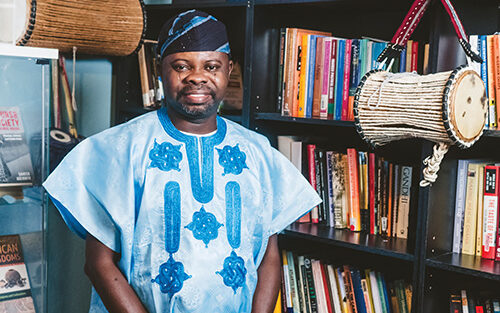
Under Professor Saheed Aderinto’s directorial dexterity, the documentary puts into illuminating perspectives the convoluted roles of women fuji artistes, their survival journeys, the delicate triumphs, and the pressures on all fronts.
II
For many millennials, Osanle was the last and perhaps most prominent queen in Fuji’s chaotic kingdom. But if Osanle challenged male patriarchy with her entrance in the 2000s, Professor Aderinto’s film shows us that she was only drawing inspiration from past musical heroines of the genre, mostly unsung.
So the ‘Women of Fuji’ documentary begins with an illuminating journey into the past, with Alake Alasela, who started off playing Waka, Awurebe, and later Fuji. The klieglights moved towards Karimotu Aduke – Sikiru Ayinde Barrister’s first wife and mother of his first son, Rasaq—who competed in Were expeditions and won prizes.
Later came Asisatu Amope, who blended Sekere with modern sounds and guitar and disrupted the space with her Ikebe Fuji Reggae (1981), earning media accolades even in the then-influential Lagos Weekend.
By far the most audacious of the women of that era, to my mind, was Mutiatu Amope, who, circa 1983, self-produced and released her own album under her own label, Iganmode Records. She would take audacity to a dizzying height when she ranked herself as the third in the Fuji hierarchy, placing herself just behind the pioneering duo of Ayinde Barrister and Ayinla Kollington, as their ‘Idowu’.
Given the sensitivity of hierarchy in Fuji at a time Iyanda Sawaba Ewenla rocked downtown Ebute Metta and Wasiu Ayinde Barrister (later Marshal) was the rave with his ‘Tala Series’, Amope’s was quite a bold one.
Like Amope, Fatimo Asade also came out to challenge Rashidi Ayinde Merenge as the first ‘Serubawon’, literally taking the fight to the arena of the top Fuji acts of that era. Many years later in the 1990s, Solape Florangba, aka Lady Matosibe also challenged Abasss Akande Obesere. For her, the goal was to free women from male chauvinism, deconstructing Obesere’s popular slang, “Tosibe”, as one that diminishes a woman’s agency.
Joy Abeke, who brought Bolojo sound of Egbado into Fuji, and Ejide Muinatu, who prides herself as the “longest reigning” female Fuji musician, also came to the limelight afterwards.
In the 2000s, Pasuma—whose prolificity in sobriquet manufacturing is legendary—named himself African Puff Daddy. He would soon be imitated by Wale Tekoma, who called himself “African Sisqo” and Remi Aluko, who earned the title of “African Fuji 2Pac”.
They all followed the footpaths of Obesere and Easy Kabaka, who had both been locked in a mortal combat over who owned the sobriquet “African Michael Jackson”. If these artistes, the younger ones especially, attempted to tap into the global fame of the artistes whose stage-names they (mis)appropriated, Fausat Makeba did the same in the years prior, by adopting Mariam Makeba’s name.
Fuji, by etymology, flows from Were, an Islamic performance staged during the fasting month of Ramadan. That genesis explains why most Fuji artistes are Muslims, but Foluke Awoleye emerged in 1992 as the “first Christian gospel Fuji musician”, with a bible in one hand and a microphone in the other, fired by a determination to preach the gospel of Christ.
All of these women, from Alasela through Fausat Makeba, seem united not just by the genesis of their artistry (they are multitalented women who excelled more with Waka, Awurebe and similar indigenous sounds, before pivoting into Fuji) but the conscious realisation that they were navigating a difficult terrain and had to come up with combative tactics to weather the storm and find a space for themselves in a fiercely competitive arena.
For them, coming to the Fuji arena is like a fighter moving around a ludus occupied by hungry gladiators baying for blood. Like Kemity, the viral sensation in Ibrahim Itele’s popular movie Koleoso, didn’t quite intone, the adventure is akin to “War war war…”
III
In his smash hit double album “High Level & Joker”, Pasuma sang about the fact of women being the harbinger of happiness, what he termed “Ugona” and “Happ-iaka”. The documentary brings some clarity to that truism, with testimonies on how the presence of women brings men to major Fuji shows.
Dayo Olomu, journalist and former artiste manager, provides insight on how artiste managers get paid by men ahead of shows, just so they can get all the attention from women. (K1, for instance, has a special anthem for the big spenders who, in turn, capitalise on the attention and glamour to attract women at shows. I witnessed this firsthand, once, around Akin Fijabi House in Itamerin, Ibadan, sometime in 2006.)
The overwhelming influence of women on the domestic front also came to the fore, with the example of Alhaja Modinatu Adedibu’s choice of Ayinde Barrister as the performing artiste at her wedding to the late Lamidi Adedibu in 1979.
That relationship will later blossom to the point that in ‘Image’ – Barrister’s tribute to Adedibu and one of the most emotive eulogies to any dead person in Fuji history – the Fuji musician wept.
Outside the domestic front, prominent women patrons also received well-deserved mentions, from Bolajoko Kadiri, Abibatu Asake (Cotonou), Jarinatu Focus, Sariyu Cooper, and of course, the charismatic Kubura Adebisi Edionsiri, whose patronage of arts was legendary, from Juju through Sakara, Apala, among other indigenous arts. Edionsiri passed on recently.
Professor Aderinto deployed the creative power of performing arts to contextualise the role of women in Fuji music, with a clip from ‘Iyawo Alhaji’, a Nollywood classic, where K1 was gifted some clothes (by women) ahead of a performance.
Since they control businesses like lounges, restaurants and all that, in the Diaspora, especially in places like the United States, women are 90 per cent ‘party-throwers’, according to music promoters like Ade Otolowo, effectively shaping the success or failure of not just diaspora Fuji artistes, but even Nigeria-based artistes who frequently travel abroad on tours.
Together with Remmy Chanter, performing artist Apeke Ajobata (who rose to relative fame, first, as my classmate in Eruwa Mass Communication department in 2006 and has since gone ahead to take the game far higher since we left the belly of hills in Ibarapaland) provided insights into the role of chants, or Oriki, in the creative development of Fuji, an area of stregth for most women.
Professor Karin Barber brought life to this episode with a blend of academic insights, raw understanding of Yoruba panegyrics, and narrative simplicity. She was a delight, just like Madam Aderinto.
IV
With fame comes women and all the delicate adventures of life, and that perhaps prompted Wale Ademowo to declare that “fame is nonsense… (fame) could kill.” BarryMade echoed same sentiment when she noted that “every woman wanted to marry Barrister” and the late Iyanda Sawaba complained of being harassed by women for failing to pay attention to them at parties despite his old age. Sefiu Alao also said he was tired of women.
But for many of the women, it was more about the economic gains that come with their association with Fuji artistes and visibility in their businesses. While the pleasure and razzmatazz could be alluring, there is some sort of economic dimension to it, as Madam Olamide Aderinto so brilliantly explained.
Fuji sensation Tiri leather provided insights on how to balance the equation, and Taye Currency brought a dramatic twist to how jealous some fuji-cians can be when it comes to women they admire, echoing Baba Adisa Osiefa’s take on the rivalry among artistes in their battles over women.
If women enjoyed the glitz and glamour of fame, Fuji artistes made the razzmatazz more desirable. And among the lot, Wasiu Ayinde holds the record for the showiest tendencies in that department, if we go by his records of composing rhythmic anthems for his women, from Sikira through Labake Khausarat, Yewande, Fathia, and Emmanuella, among others.
I’d argue that the large harem of women isn’t even confined to the space of religious identities alone; musical artistes, irrespective of religious persuasion, maintain a large harem to proclaim their artistic dominance and masculinity.
Motherhood is a sensitive institution in the lives of many Fuji musicians, given the number of concubines they have to contend with. And so, a child effectively registers the woman’s presence not just in the life of the fujician (Professor Aderinto has the ‘copyrght’ for the coinage) alone, but also the nomenclatural identity of the woman herself, like Sefiu Alao’s daughter, Dr. Nofisat Adekunle whose mum bears the eternally enduring title of “Iyawo Sefiu” despite not being married to the Fujician, rightly pointed out.
The point was lucidly made in yet another clip showing a proud Sefiu eulogising his daughter for her doctorate degree.
In this documentary, Nollywood meets Fuji, as exemplified in Princess Lanko’s hilarious depiction of how Wasiu Ayinde reportedly makes promiscuous advances with arty nonchalance and Dudu Alabi-Hundeyin depiction of the philandering tendencies in Iyawo Alhaji.
In Fuji world, success comes with some degree of anxiety that’s haunting in its permanence. No other artiste could have explained it better than the late Iyanda Sawaba, who, perhaps, experienced the most touching episodes of tragedies among fujicians across generations.
Not long after releasing his smash hit Pata Olokun, he lost nearly everything. Earlier, before the tragedy struck, he had an altercation with Ayinde Barrister, fuelling insinuations among Fuji buffs that there was some spiritual dimension to his ordeals.
With such tragedies come the need for the artiste to embrace spiritualities, and the women – their wives and, especially, mothers – play important roles in this. That accounts for the central roles of mothers in the lives of these artistes, reason why they are the most famous in their lives: Barrister had Odere Shifau; Wasiu Ayinde had Halimo Shadia; Pasuma had Adijatu Kuburah. The one question has always remained: where are their fathers?
Well, Tiri Leather provides some insights, providing references to the god-like position of mothers in the lives of humans, with claims from Yoruba cosmology and Islamic jurisprudence.
Weekly ‘Jump’ (stage performance) provides the artistes with confidence, morale-boosting energy and a potpourri of street slang that bring life to their innovative skills. In fact, artistes like Atawewe and Remi Aluko had more memorable lines and performances from Jumps than they had from studio albums.
What Were did to the early year artistes, Jump did for the latter-day artistes of the late 80s through the early 90s. But ‘Jump’ can be very difficult to put together for women artistes, which also accounts for the relative success of most female artistes among their peers.
Apart from the burden of domestic responsibilities or motherhood, the physical threat of violence can be off-putting. Tosin Eniba recounted sexual assault on her members, one she chose to couch in euphemistic description, even as that could barely cover up the trauma that comes with such risks.
Ejide’s account of nearly giving birth to her child on the stage opens a window into the interconnected nature of domestic and artistic life of women artistes, a burden that men do not necessarily bear. Their stories on how they combine that delicate stage of breastfeeding with artistic creativity without missing out on the big stage speak to one oft-neglected area of resilience that defines the career of these women.
That some women had to quit due to sexual harassment also speaks to the reality that patronage could wither due to unreciprocated sexual gestures, a concern that men hardly have to tackle.
The documentary delves into the tonal differences in the sounds of male and female Fuji artistes. We are told here that K1’s classical music style had the most phenomenal impact on Fuji evolution, making what seemed a complex, convoluted art easily approachable for many.
Wasiu Ayinde’s tonal inventiveness, which makes narrative storytelling quite easier than the style adopted in the early years, brought life to live performances. Although the style is often criticised for being banal, especially in the early years, it has since taken on a life of its own, especially after the release of Solo Makinde, off his 1999 album Fuji Fusion.
The influence of Afrobeats is palpable in the sound as much as the makeup of what a typical Fuji band should be. Like some of their Juju counterparts, many Fuji artistes don’t own a band but rely on the topsy-turvy nature of the digital space for creative survival.
Even K1 acknowledged this with his recent album by relying on digital productions, with the line: “Aye digital l’awa o.” The flexibility also comes with virality and ease of attaining stardom. With a single viral video, an artiste can be catapulted from obscurity to the zenith of stardom, a reality that would have been impossible without heavy media exposure and big budgets in the decades prior.
Professor Aderinto and crew must have opened new insights into how gender complexities play into the roles of men and women in the evolution of Fuji, ultimately defining the success or failure of artistes across generations.
Since Osanle Iyabo passed in 2009, I’d argue that Fuji hasn’t seen another queen with such dexterity of influence and street credibility. Tope Makanaki and Fatimo Cinderella, who came after her, haven’t been particularly competitive and enduring on the big stage.
Why hasn’t any other artist taken the centre stage? I think that’s one important question Professor Aderinto’s masterful handling of the issues in this documentary may have provided insight into.
The pedant enquiry remains, still: will Fuji ever throw up another queen?
Source: Original Article • AI-enhanced version for clarity & Nigerian context


