Food prices dropped by 50% amid agricultural reforms — Minister
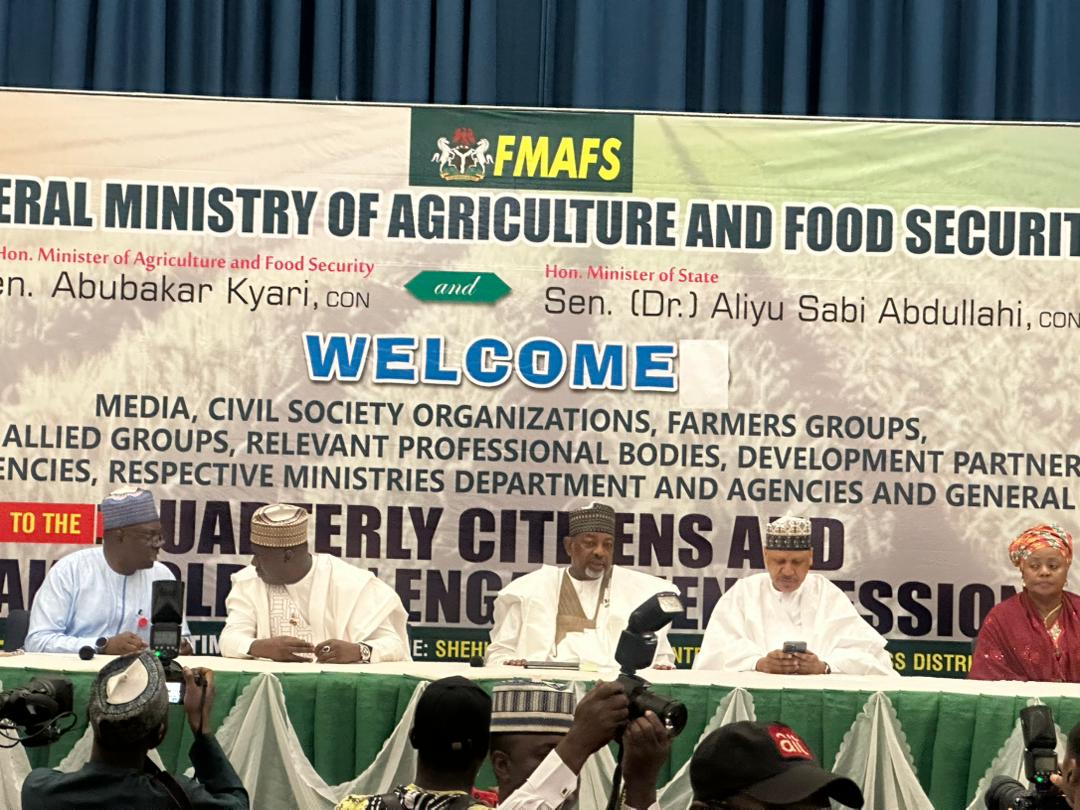
The Nigerian government has said its agricultural reforms are beginning to yield results, with prices of essential food commodities dropping by as much as 50 per cent nationwide.
The Minister of Agriculture and Food Security, Abubakar Kyari, stated this while speaking at a quarterly citizens’ engagement session in Abuja on Friday.
According to the ministry’s Permanent Secretary, Marcus Ogunbiyi, the primary goal of the engagement was to foster strong and enduring partnerships with key stakeholders.
“We aim to strengthen open and transparent communication channels where your concerns are heard, your questions addressed, and your recommendations carefully considered,” he said.
He added that collaboration would help ensure that government policies and programmes are informed by practical insights, field experiences and technical expertise.
Prioritising food security
In his remarks, Mr Kyari said the administration of President Bola Tinubu has prioritised food security as a central pillar of national stability and economic development.
“Since assuming office, this administration has made food security a top priority, acknowledging the critical role it plays in maintaining national stability and sovereignty,” Mr Kyari said.
“To achieve this, we are focusing on boosting local production and reducing our reliance on imports, with the ultimate goal of making affordable, nutritious food accessible to all Nigerians.”
The minister added that government interventions are beginning to reflect in market prices.
“Our efforts are starting to pay off, with a notable impact on food prices. In fact, prices of essential food commodities have dropped by 50 per cent nationwide,” he said.
Nigeria’s food insecurity crisis
Nigeria has, in recent years, grappled with a severe cost-of-living crisis, largely triggered by President Tinubu’s economic reforms, particularly the removal of petrol subsidies and the floating of the naira.
The policies sharply increased the cost of living, with food prices more than doubling in many parts of the country compared to levels before Mr Tinubu assumed office.
Food inflation rose sharply before moderating slightly following the rebasing of the Consumer Price Index (CPI) by the National Bureau of Statistics (NBS) early last year.
The crisis also sparked nationwide hunger protests, with many Nigerians expressing frustration over the government’s handling of the economy. Despite interventions such as an increased minimum wage and food subsidies, the impact has remained limited, as food prices remain high amid declining purchasing power.
The situation has been widely described as dire, with many families struggling to afford basic necessities. During the 2024 festive season, fatal stampedes were recorded during relief food distributions in several parts of the country.
Beyond weak policy implementation, food system experts have repeatedly identified climate change, poor post-harvest handling, inadequate storage and transportation infrastructure, and weak market regulation as major drivers of the food insecurity crisis.
In a recent warning, the United Nations, through its Office for the Coordination of Humanitarian Affairs (OCHA) in Nigeria, said about 35 million Nigerians could face acute hunger this year.
Government interventions
At Friday’s engagement, Mr Kyari highlighted several initiatives introduced by the ministry to stimulate production and support farmers.
He said that over the last two years, the government has distributed more than 1.9 million bags of fertiliser to nearly one million farmers, while also strengthening regulatory frameworks to curb the circulation of fake fertilisers in the market.
The minister said the government has also established a National Reference Laboratory and upgraded the National Fertiliser Management Platform to improve quality control and transparency in the fertiliser supply chain.
He added that partnerships with countries such as Russia, Türkiye, India and Canada have helped Nigeria improve fertiliser production and access to modern agricultural technology.
Value-chain development
Mr Kyari said the government has prioritised several key agricultural value chains, including rice, maize, wheat, sorghum, millet, cassava, cocoa and oil palm, in a bid to increase productivity and create opportunities for farmers.
He said the interventions — ranging from improved seeds to pest control kits and farmer training — are helping smallholder farmers transition from subsistence farming to agribusiness.
“These interventions have empowered farmers to boost productivity, reduce losses, and improve produce quality, ultimately enhancing their livelihoods and contributing to a more robust agricultural sector,” he said.
Mechanisation push
The minister also highlighted the launch of 2,000 tractors and other agricultural equipment under the Renewed Hope Agricultural Mechanisation Programme.
He said the initiative aims to establish mechanisation centres across the country to improve efficiency in farming operations.
According to him, the government is also strengthening agricultural research and development through the Agricultural Research Council of Nigeria, which recently distributed 40 million cocoa seedlings to support long-term growth in Nigeria’s cocoa industry.
Support for farmers
Mr Kyari said additional support is being provided through the National Agricultural Growth Scheme Agro-Pocket programme, which has registered more than 647,000 farmers nationwide and provided subsidised inputs to over 622,000 of them.
He added that the federal government has approved a N250 billion facility for the Bank of Agriculture to expand access to affordable credit for smallholder farmers.
According to him, the government is also strengthening agricultural insurance through the Nigerian Agricultural Insurance Corporation to improve farmers’ resilience to risks.
Mr Kyari said the government is working to strengthen the country’s national food reserves to cushion the effects of disasters, conflicts and economic shocks.
He added that rural development initiatives — such as the construction of roads, boreholes and solar-powered streetlights — are also improving connectivity and market access for farming communities.
Call for collaboration
The minister urged stakeholders across the agricultural sector to continue supporting government efforts to transform Nigeria’s food systems.
He said collaboration among government agencies, development partners and the private sector would be crucial in achieving sustainable food security and economic growth.
“While challenges persist, we are working tirelessly to overcome them,” he said.
“Achieving these goals requires a collective effort, sustained energy, partnership, and alignment of our initiatives and resources.
Source: Original Article • AI-enhanced version for clarity & Nigerian context