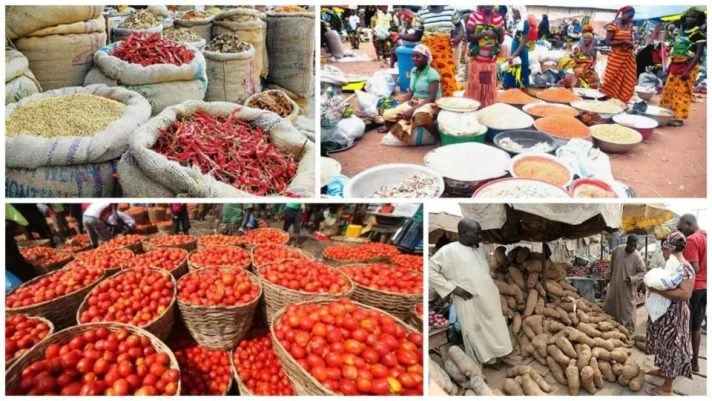
Food inflation in Nigeria increased to 16.96% year-on-year in May 2026, up from 16.06% in April, according to the National Bureau of Statistics. On a month-on-month basis, food prices rose by 2.98% in May, driven by price increases in onions, maize, cassava flour, tomatoes, yam, plantain, and other staple foods. The year-on-year food inflation rate was highest in Adamawa at 29.62%, followed by Kwara at 28.47% and Rivers at 28.40%. Borno recorded a negative food inflation rate of -6.53%, indicating a drop in food prices, while Taraba and Bayelsa saw minimal increases at 1.13% and 5.99% respectively.
On a month-on-month basis, Bauchi recorded the highest food inflation at 7.73%, followed by Ogun at 6.86% and Jigawa at 6.69%. Niger, Katsina, and Gombe experienced declines, with food prices falling by -3.54%, -3.48%, and -2.22% respectively. The overall headline inflation rate also rose, reaching 15.93% in May from 15.69% in April. The main contributors to headline inflation were Food and non-alcoholic Beverages at 6.38%, Restaurants & Accommodation Services at 2.06%, and Transport at 1.70%. The least contributors included Recreation, Sport, and Culture at 0.05%, Alcoholic Beverages, Tobacco, and Narcotics at 0.06%, and Insurance and Financial Services at 0.07%.
Core inflation, which excludes volatile agricultural and energy prices, stood at 16.82% year-on-year in May, up from 15.90% in April. On a month-on-month basis, core inflation was 1.94% in May, an increase from 1.03% in April. At the state level, Yobe recorded the highest headline inflation at 24.94%, followed by Anambra at 23.29% and Sokoto at 22.60%. Niger, Plateau, and Edo had the lowest year-on-year headline inflation at 3.07%, 7.10%, and 7.73% respectively. Month-on-month, Benue, Bayelsa, and Borno saw the largest increases in headline inflation, while Niger, Zamfara, and Taraba recorded declines.
The National Bureau of Statistics reports rising food prices even as some states record falling inflation, exposing regional disparities in cost of living. Nigerians in Adamawa, Kwara, and Rivers face food inflation nearly double the national average, while those in Borno and Niger see relative relief. The divergence suggests policy impacts are uneven across regions, with no uniform relief for households. This unevenness undermines claims of broad-based economic stabilization.
Editorial note: AI-assisted opinion, not established fact. Full disclaimer →


