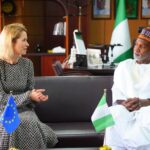
The European Union has announced a significant expansion of its strategic partnership with Nigeria, unveiling a €290 million investment package. This announcement was made during the Eighth Nigeria–EU Ministerial Dialogue, co-chaired by Nigeria's Minister of Foreign Affairs, Yusuf Tuggar, and EU High Representative for Foreign Affairs and Security Policy and Vice President of European Commission, Kaja Kallas.
The investment package, under the EU's Global Gateway Strategy, aims to support digital infrastructure, healthcare manufacturing, agricultural value chains, and migration management. The European Investment Bank's development arm, EIB Global, and the Bank of Industry (BoI) have also signed a €50 million financial agreement to boost the local healthcare sector in Nigeria.
The agreement will target unmet medical needs and deliver a credit line to support local manufacturers of medicinal products and devices, such as pharmaceuticals, vaccines, and diagnostics. Furthermore, a €85 million agreement has been signed to boost the development of Nigeria's agricultural value chains, with at least 70 per cent of the loans targeting cocoa and dairy value chains.
The healthcare deal was witnessed by Minister of Budget and Economic Planning, Senator Abubakar Bagudu, Ambassador of European Union in Nigeria and ECOWAS, Mr. Gautier Mignot, Managing Director/Chief Executive, BoI, Dr. Olasupo Olusi, and EIB Head of Unit, Svetla Stoeva.
The €290 million investment package is a significant boost to Nigeria's healthcare sector, which has long struggled with inadequate funding and infrastructure. The partnership between the EU, EIB Global, and BoI is a crucial step towards strengthening health security and catalysing industrial growth, skills development, and high-quality job creation. However, the success of this initiative will depend on the ability of Nigerian enterprises to scale, innovate, and meet international quality standards. The fact that at least 70 per cent of the loans will target cocoa and dairy value chains suggests a focus on key sectors that can drive economic growth. As Nigeria continues to grapple with healthcare challenges, this investment package offers a glimmer of hope for improved health outcomes and economic development.