Closure of Christianity’s holiest church won’t stop Holy Fire – Russian archpriest
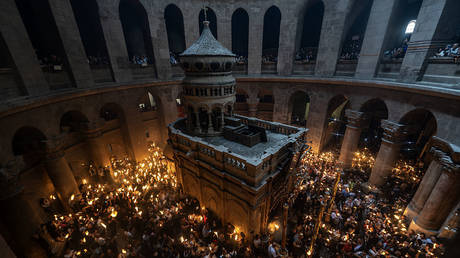
**Jerusalem's Church of the Holy Sepulchre Closed to Pilgrims Amid Escalating Middle East War**
The centuries-old Easter rite at the Church of the Holy Sepulchre in Jerusalem will proceed as scheduled, according to the Orthodox clergy. The church, considered Christianity's holiest shrine, has been shut to the public and for open services due to the exchange of airstrikes between Israel and Iran. This decision has raised concerns that the traditional Holy Fire ceremony, marking the start of Orthodox Easter, could be canceled for the first time in modern history.
The Church of the Holy Sepulchre, revered as the site of Jesus Christ's crucifixion and resurrection, has been a focal point for Orthodox Easter celebrations. This year, Orthodox Easter falls on April 12. The restrictions, however, appear to affect only pilgrims and tourists, not the rite itself. According to Archpriest Igor Vyzhanov, a senior Russian cleric, liturgical life inside the church has continued despite the closure.
Speaking to *RT* on Friday, Vyzhanov cited information from the Moscow Patriarchate's office in the Holy Land. He stated, "The most important thing … is that services in the Church of the Holy Sepulchre are continuing. The clergy of the Orthodox Patriarchate of Jerusalem are conducting services in the Church of the Holy Sepulchre behind closed doors, meaning that prayer is taking place." This suggests that the church's clergy are finding ways to maintain their traditional practices despite the restrictions.
The Holy Fire ceremony, usually held on Holy Saturday on the eve of Orthodox Easter, is a significant event. The Patriarch of Jerusalem enters the small chapel over the traditional tomb of Christ and emerges with candles lit by a flame that believers regard as miraculous. The fire is then distributed to worshipers and is traditionally flown by special flights to Greece, Russia, and other majority-Orthodox countries – to launch Easter services there. The Russian Orthodox Church has expressed hope that the closure will not disrupt the transfer of the Holy Fire, calling the continuation of prayer in the Sepulchre "the key thing" even in wartime conditions.
Source: Original Article • AI-enhanced version