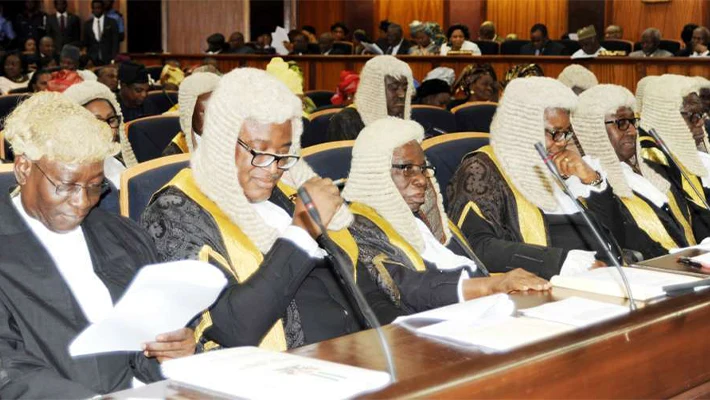
In August 2025, the Sultan of Sokoto stated at the Nigerian Bar Association's annual conference that judicial verdicts in Nigeria had become a "purchasable commodity". This observation aligns with growing concerns about the role of courts in Nigerian politics, where judges are increasingly seen as active participants in partisan conflicts. A 2024 by-election for the Ebonyi South senatorial seat saw Federal High Court Judge Hyeladzira Nganjiwa disqualify PDP candidate Silas Onu two days before voting. The Court of Appeal later vacated the order, but the damage was already done.
The Court of Appeal, in an earlier ruling on David Mark's appeal against an interim order by the Federal High Court, emphasized that the text of a court's ruling must prevail over an enrolled order if contradictions exist. Yet the court did not address why such contradictions occur so frequently. According to the Journal of Democracy article by Andrew O'Donohue of the Harvard Radcliffe Institute, courts can undermine democracy by enabling authoritarianism, distorting elections, restricting civic rights, empowering unelected elites, or exceeding jurisdiction. These patterns are evident in Nigeria.
The Supreme Court once assumed appellate jurisdiction over a case still pending at the Federal High Court in Port Harcourt, effectively choosing a side in a political dispute. Similarly, on April 8, a court claimed jurisdiction to overturn a Court of Appeal decision in a case from the NICN involving a former deputy governor of Kogi State—an action that has raised legal eyebrows. The Africa Report has warned that mutually contradictory orders from courts of equal standing threaten the rule of law in Africa's largest democracy. The phenomenon of "verdict without judgment" creates legal vacuums that cause foreseeable and unpredictable harm.
A judge disqualified a senatorial candidate two days before an election, a move undone months later by a higher court, yet the political outcome remained unchanged. This shows that in Nigeria, a delayed judgment is effectively a weapon, not a failure of process. When courts issue orders without immediate rulings, they create damage that cannot be reversed by later corrections. The system rewards tactical judicial interference, not justice.
Editorial note: AI-assisted opinion, not established fact. Full disclaimer →