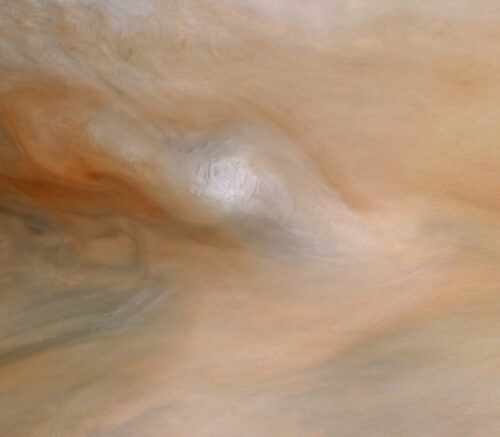
NASA's Juno spacecraft is still providing valuable scientific data from its mission to Jupiter, despite concerns that the mission might be terminated due to budget constraints. The spacecraft has been observing Jupiter's colossal storms, which generate lightning flashes that are at least 100 times more powerful than those on Earth. Scientists have been analyzing data from Juno's observations in 2021 and 2022, and their findings were published in the journal AGU Advances on March 20.
Juno's continued operation is a result of an extension granted by NASA after the spacecraft completed its initial five-year science campaign. However, the mission's future is uncertain, as NASA officials have not confirmed whether they will approve another extension. The main reason for the uncertainty is the significant budget cut proposed by the Trump administration, which would slash NASA's science budget by nearly half.
The budget cut has forced NASA officials to make tough decisions about which missions to prioritize. While some missions, such as the OSIRIS-APEX and Lunar Reconnaissance Orbiter, have received approval to continue operations, others, like Juno, are facing an uncertain future.
The uncertainty surrounding Juno's mission serves as a reminder of the challenges faced by space agencies in balancing scientific discovery with budget constraints. As a hub for tech innovation, Nigeria can learn from the global space industry's approaches to resource allocation and prioritization. The likes of Andela, a leading tech talent accelerator, and TechCabal, a prominent tech media platform, can draw inspiration from the strategic decisions made by space agencies like NASA.


