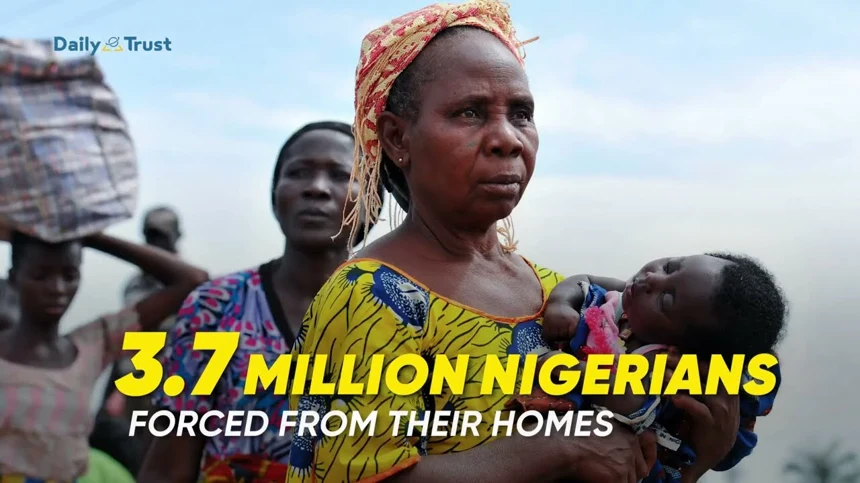
Over 3.7 million Nigerians are currently living as Internally Displaced Persons (IDPs) as of March 2026, according to a recent assessment. The displacement has been driven by ongoing insurgency, banditry, and climate-related disasters that have uprooted communities across several states. Borno, Benue, and Zamfara are among the hardest-hit areas, where violence and environmental stress have forced families to flee their homes. Many of these displaced persons now live in overcrowded camps with limited access to food, clean water, and healthcare. Conditions in the camps are described as dire, with children and elderly populations particularly vulnerable. The World Bank has approved a $300 million project called SOLID, aimed at helping 7.4 million affected Nigerians move from aid dependency to self-reliance. The initiative focuses on improving access to basic services, livelihoods, and social protection for displaced populations. While funding offers some hope, persistent insecurity across northern and central Nigeria continues to hinder return efforts. There is growing concern that without lasting peace and infrastructure restoration, repatriation remains unlikely. The crisis spans multiple regions and shows no signs of abating in the near term. Humanitarian agencies warn that emergency support alone cannot address the scale of displacement. Long-term solutions require coordinated action on security, climate adaptation, and economic inclusion. No official timeline has been provided for the full implementation of the SOLID project.
The government claims to prioritize national stability while over 3.7 million citizens remain displaced with no clear path home. The World Bank's $300 million SOLID project targets 7.4 million people, yet displacement continues to grow in Borno, Benue, and Zamfara. Security conditions prevent returns, meaning aid cannot replace safety. Without ending violence in these states, self-reliance programs will operate in permanent crisis mode.
Editorial note: AI-assisted opinion, not established fact. Full disclaimer →